Natural Parks
Sultanpur National Park
A shallow wetland on the Gurugram-Farrukhnagar road that draws Siberian cranes, flamingos and 250 other bird species between October and March.
Sultanpur is a compact 1.4 sq km lake-and-scrub reserve twenty kilometres west of Gurugram, and it is the region's most important birding site. The winter migration between October and March brings greater flamingos, common cranes, ruff, black-winged stilts and, in good years, the rare Siberian crane. Even in summer around 70 resident species stay put — painted storks, spot-billed pelicans and the elusive Indian roller. It is a genuine national park, not a landscaped garden, and the birding is serious. The lake was notified as a bird sanctuary in 1972 after Delhi birdwatchers lobbied for it, upgraded to national park status in 1989, and added to the Ramsar list of wetlands of international importance in 2021. Plan it as a focused two-hour birding morning rather than a family day out and it will repay the drive; plan it as a picnic and you will wonder why you came.
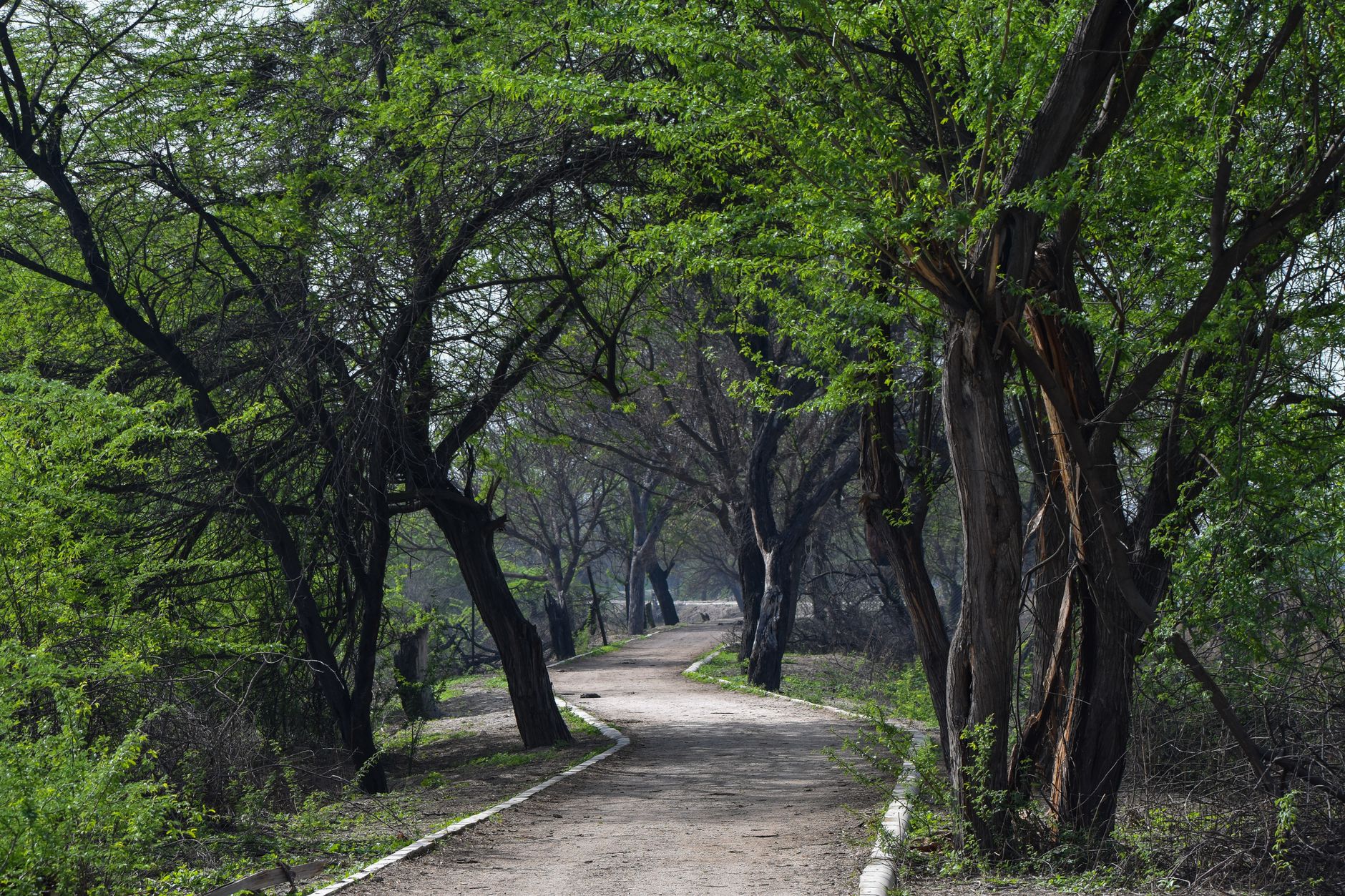
A single 3.5 km walking loop runs around the lake with four watchtowers spaced along it. The first tower is 300 metres from the entrance and gives the best sunrise light; the third, at the far end, sits over the deepest water and holds most of the wading birds. Signage identifies common species and a small interpretation centre near the gate has a stuffed-specimen display of the migrants. Guides can be hired at the ticket window for ₹500 for two hours and are worth it for first-time birders. The track itself is a firm brick-and-earth path with no vehicles allowed beyond the gate, shaded in patches by kikar, neem, ber and jamun. Nilgai graze the scrub on the southern arc in the early hours and you may meet a jackal or a mongoose crossing the path. Walk the loop clockwise so the low sun is behind you at towers 1 and 2.
Come between November and February, at dawn if possible — the park opens at 6:30am and the birds are most active in the first two hours. Wear muted colours, bring binoculars (or hire them at the gate for ₹150) and a hat. There is a small canteen but nothing serious to eat; combine with breakfast on the way back at a Sohna Road cafe. The park is closed Wednesdays. Photography is allowed but tripods over 1.5 metres need prior permission. Nothing is bookable in advance and nothing needs to be: tickets are sold at the window from opening. Carry a litre of water per person, a small torch for the pre-dawn walk to the gate in December, and mosquito repellent if you come after rain. Skip the guided nature-camp packages sold by tour operators in Delhi at four to five times the gate price; the on-site guide does the same job.
There is no metro anywhere near the park, and there will not be one; the Yellow Line's terminus at Millennium City Centre Gurugram sits about 22 km east, so the last leg is a road journey whichever way you arrive. From Cyber City the quickest run is out towards Basai and then west through Chandu Budhera on the Gurugram-Farrukhnagar road — roughly 20 km, 35 to 40 minutes if you leave before 6am, closer to an hour once Basai Road traffic thickens. A cab runs ₹450 to ₹600 one way; book a round trip or pay the driver to wait, because app pickups at the gate are patchy and you can lose twenty minutes on a village roadside. Self-drivers park free on the unpaved ground outside the ticket window. Haryana Roadways buses towards Farrukhnagar and Jhajjar leave Gurugram's bus stand and pass the gate for well under ₹50, but they will not get you there at 6:30am.
The gate charge is ₹40 for Indian visitors and ₹400 for foreign passport holders, with ₹50 more for a still camera; phone photography carries no fee, so leave the DSLR behind if you were only ever going to shoot the lake and skip the surcharge. Children under 5 enter free. Binocular hire is ₹150 a pair and a guide is ₹500 for two hours, which for two people works out cheaper than the cab and will add a couple of dozen species to your list. Parking costs nothing. Tea and packet biscuits at the canteen come to ₹20-30. Two Indian adults with one camera and one hired pair of binoculars therefore spend around ₹280 inside the park, and three to four times that on transport. Carry small notes — the ticket window is a cash operation on most mornings.
January is the best month, December and February close behind; that is when flamingo, shoveler, pintail, teal and ruff numbers peak and the water is high enough to spread them across the shallows. The first migrants arrive in October, the last stragglers leave by mid-March. April to June is brutal — 44°C by mid-morning, the lake shrunk to mud, only residents left — and there is no honest reason to come. July to September greens the scrub and puts painted storks, cormorants and herons into the nesting trees, but the path turns sticky and the mosquitoes are ferocious. Within the day, 6:30 to 8:30am is the window that matters; between 10am and 3pm the birds sit tight and you walk 3.5 km for very little. Wednesday is closed, Sunday is loud with school parties. Aim for a Friday in mid-January, at the gate before the ticket window opens.
It suits birders, patient photographers with 400mm and above, and children of about six upwards who can manage a flat 3.5 km without complaint — give a bored teenager the binoculars or the camera and the visit changes character entirely. Toddlers need a carrier. Wheelchair users can do the first level, firm kilometre from the gate, which covers towers 1 and 2 and a good stretch of open water, but the towers are stair-access only and the far side of the loop is rough and uneven. Skip it if you have a single free hour before a train — the drive alone eats eighty minutes return. Skip it on a wet afternoon; the only shelter is the towers. And skip it if you are hoping for a safari: there are no jeeps, no big mammals beyond nilgai and jackal, and you walk.
Fold in Farrukhnagar, 6 km and about twelve minutes further west — an eighteenth-century salt town with the Sheesh Mahal built by Faujdar Khan, the octagonal Ghaus Ali Shah baoli, the Jama Masjid and the Delhi Gate, all free to walk around and worth 45 minutes. Serious birders pair Sultanpur with the Basai wetland roughly 12 km back towards Gurugram, which is unprotected and free and often holds more waders than the park does; the standard local routine is Sultanpur at dawn, Basai at nine. For breakfast on the return leg, 32nd Avenue on NH-48 near Kherki Daula is about 25 minutes from the gate. If you want to be at the gate at opening without a 5am alarm from Delhi, Heritage Village Resorts & Spa Manesar Gurgaon is the closest comfortable base, about half an hour away.
The honest caveats: this is not Bharatpur. Keoladeo is 29 sq km and four hours south; Sultanpur is a fenced 1.4 sq km depression with a road audible from the far bank, and people who arrive expecting wilderness leave disappointed within the hour. Water levels are managed and topped up, and in a dry winter the lake shrinks and the bird numbers fall with it — check recent eBird checklists for Sultanpur the night before rather than committing ₹1,000 of cab fare on hope. Flamingo flocks are a good-year event, not a guarantee. The interpretation centre is a ten-minute stop and looks its age. The canteen will not feed you a meal, weekend groups can be noisy on the loop, and the litter along the outer fence is real. Come early, come in January, and the place is excellent; come casually at noon in May and it is a hot walk round a puddle.
Hours & entry
Not free
Tue-Sun 6:30-16:30 · Wed closed
What to see
{'what': 'Watchtower 3 at sunrise for the flamingo flock', 'where': 'Far western end of the perimeter loop'}
{'what': 'Interpretation centre and species map', 'where': 'Just inside the main gate'}
{'what': 'The old peepal grove where painted storks nest', 'where': 'Between towers 1 and 2 on the north path'}
Tips from the ground
Arrive at 6:30am opening — by 10am the birds retreat into cover.
Rent binoculars at the gate if you did not bring any — the ₹150 pair is decent.
Sundays are crowded with school groups; go on a Tuesday or Friday.
Good to know
Questions, answered
What is the entry fee?
₹40 for Indian visitors, ₹400 for foreign nationals; extra ₹50 for cameras. A phone camera carries no charge, so leave the DSLR at the hotel if you were not going to use it seriously. Binoculars hire for ₹150 a pair, a guide costs ₹500 for two hours, and parking outside the gate is free. Two Indian adults with binoculars and one camera spend around ₹280 inside. Bring cash in small notes — the ticket window does not reliably take cards.
Are there free days?
No, but children under 5 enter free with an adult. There is no free hour, no free national-holiday entry and no evening concession; the ₹40 applies equally at 6:30am and at 4pm. The only real way to cut the cost is to bring your own binoculars, shoot on a phone rather than paying the ₹50 camera fee, and share a cab — transport, at ₹450 to ₹600 each way from Cyber City, costs many times more than the ticket ever will.
How long is the walk?
The full loop is 3.5 km and takes two hours at birding pace. Walked briskly without stopping it is about 45 minutes, but that defeats the purpose. Budget 30 to 40 minutes sitting at watchtower 3 where the deep water holds the waders, ten minutes at the interpretation centre, and three to four hours total if you are photographing. Add 40 minutes of driving each way from central Gurugram, so a dawn visit puts you back in town around 10am.
When is the park closed?
Every Wednesday, and last entry is at 4:30pm year-round. Gates open at 6:30am and the first two hours are far and away the most productive, so a late-afternoon arrival gives you a short, quiet, thin-birding window. If Wednesday is the only morning you have free, drive instead to the open Basai wetland about 12 km back towards Gurugram, which is unprotected, unfenced, free and frequently just as good for waders.
Do I need to book?
No advance booking required — tickets are sold at the gate. There is no online system and no timed entry; you turn up, pay and walk in, with a queue of five to ten minutes at most on a busy Sunday morning. Guides are hired at the same window on a first-come basis, so arrive at opening if you want one in peak season. Groups of twenty or more should write to the Haryana Wildlife Department beforehand. Foreign nationals should carry a passport for the ₹400 rate.
How do I reach it?
There is no metro; take a taxi from Cyber City (30 min, around ₹500 one way) or self-drive via the Farrukhnagar road. The nearest metro station is Millennium City Centre Gurugram on the Yellow Line, about 22 km east, from where a cab is ₹450 to ₹600. Self-drivers use the free unpaved parking outside the ticket window. Book a round trip or pay your driver to wait — app pickups at the gate are unreliable at 9am. Farrukhnagar railway station is 6 km away but its timings suit nobody.
Doing good is the business: every booking through Stay Gurugram funds one verified tonne of carbon removal — same room, same price, no markup.
Start your search